

Folklore & Mythology

Scandinavians and Nature
Scandinavia, consists of Norway, Denmark, and Sweden are a region that revolves around nature. From the region's geography, to people's lifestyle, and to cultural values. From the thick forests to the deep lakes, the vast mountains to the shadowy mist, the Scandinavians are in one with the nature.
This is precisely why even the folklores and mythology of the Scandinavia connect closely with the nature.
Although apart from that particular reason, the Scandinavian folklores and myths have their links to the ancient Norse mythology, with the correlation and adaptation to Christianity.
All of these has transformed to a fascinating tale of survival and adaptation of the Scandinavians, moving from the halls of the gods into the daily lives, forests, and farms of the local peasantry.
Curious? Let's indulge in this together!
Common beings in Norse mythology
01
Gods (Aesir and Vanir)
In Norse mythology, there are two types of gods: the Aesir and the Vanir. Aesir, live in Asgard and is led by Odin is very wise and sacrificed one of thus eyes to gain more knowledge. These gods are Thor and Odin.
Meanwhile Vanir is another group of gods associated with nature, vegetation, and fertility. These gods are Freyja, the god of love and life, and Njord, the god of the sea and winds.
03
Elves
There are two types of elves, the light elves and the dark elves. As suggested by the name, the light elves and good and bright meanwhile dark elves are secretive and shadowy.
05
Valkyries
Valkyries are Odin's fierce and armored shieldmaidens who carry Einherjar (fallen warriors' souls) to either Fólkvangr (Freyja's celestial field) Valhalla (Valhöll, meaning "Hall of the Slain"), an enormous, majestic hall located in Asgard (the realm of the gods).
Valhalla serves as a paradise for warriors who die bravely in battles. Although their definition for 'paradise' is an eternal training camp for elite army to prepare for Ragnarök, the cataclysmic twilight of the gods.
02
Giants
Similar to what often shown in movies, giants are strong and huge creatures that are often threatening and dangerous.
04
Dwarves
Contrary to giants, dwarves are small yet wise beings that lives underground. These beings are what said to be crafting magical items like Thor's hammers, and Gleipner (a magical ribbon made for impossible things).
06
Wolves and Serpents
In the ancient Norse mythology, the wolves like Fenrir and serpents like Jörmungandr are the only forces that can challenge the gods hence described as has the "inescapable nature of destruction". They are said to be beasts of a ticking clock, forces of nature that the gods could only delay, but never truly stop.
07
Norns
Norns are powerful, mysterious fate goddesses who spin the threads of life to determine destinies of humans and gods. They are called the goddesses of destiny.
Norns are arguably the most influential beings in the entire nine realms because their decrees are absolute. Even the mighty Aesir gods like Odin are subject to the fates the Norns weave.
Scandinavians Folklore
Scandinavian folklore is a rich tapestry of oral traditions, beliefs, and legends stemming from Norway, Sweden, and Denmark. While it is distinct from Norse mythology (which focuses on the grand tales of Viking gods like Odin and Thor), folklore represents the everyday beliefs of rural communities, passing down generations long after the Christianization of the region.
These tales served a dual purpose: they explained the mysterious, often harsh forces of the Nordic landscape and provided moral lessons to keep community members safe.
Each of these count


The Boy Who Had an Eating Match with a Troll
A popular tale from Norway tells the story of Askeladden. He was the youngest son of a farmer in heavy debt. His two older sons went into the forest looking for wood to repay debts. But they were scared away by the trolls and returned with nothing. Askeladden then tried his luck, taking along a piece of cheese in case he got hungry.
Askeladden encountered the angry troll and used the cheese to pretend he was clutching a rock. Squeezing it until whey came out, Askeladden was able to fool the troll into thinking he had superior strength. The troll offered to help the boy cut wood, after which he invited the boy for a meal.
As the troll tended the fire, he asked Askeladden to fetch water in two large buckets. The boy realised he couldn't carry them so fobbed off the troll claiming they were too small. He said instead that he would bring the whole spring.
The troll instead chose to get the water while the boy tended the fire. Once the porridge was ready, they ate and ate. The boy placed his knapsack under his shirt and slashed a hole in it. While the troll thought he was eating a lot, the boy was actually filling the knapsack and letting it leak out.
One the troll was full, the boy suggested that the troll cut a hole in his stomach, like they boy appeared to have done. That way he could eat as much as he wanted! The troll (they are stupid, remember) did so and died. Askeladden returned to the farm with the troll's silver and gold so the farmer could pay off his debts.

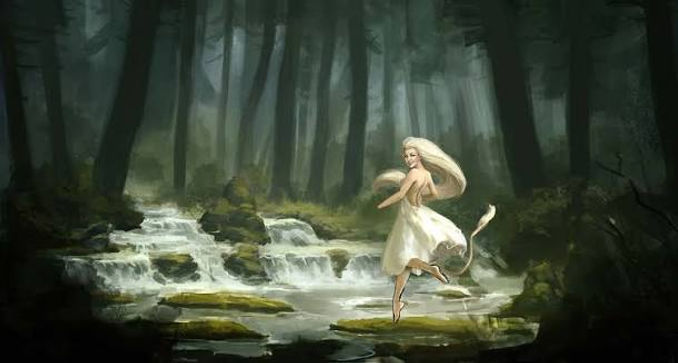
Huldra – The Seductive Forest Spirit
The seductive ‘huldra’ could be described as Scandinavian folklore’s take on the siren. In Swedish folklore, this irresistible being is also known as ‘skogsrå’ – forest spirit – or ‘Tall-Maja’ (Pine Tree Mary).
With roots in Christianity, the origins of the huldra unfolds in a tale about a woman who’d only washed half of her children when God appeared at her cottage door. Deeply ashamed about her dirty children, she hid them from sight, whereupon God commanded them forever hidden from humanity. And thus, they became ‘hulders’, the collective name for these “hidden folk”.
In Swedish mythology, the huldra is mostly seen as a benign spirit, known to be kind to charcoal burners, allowing them to sleep restfully by keeping an eye on their charcoal kilns. By way of thanking her, the charcoal burners would leave provisions.
But her dangerous side has been revealed in some tales, recounting how she lures men with her charms, carefully hiding her cow’s tail by tying it in a knot under her skirt. The only way for her to lose her tail is if she gets married inside a church, when her tail will drop off, and she’ll transform into a human.
The female hulder, whether devious or not, is almost exclusively portrayed as a beautiful being, but if you come across the male equivalent, the ‘huldrekall’, you might find him somewhat less appealing – grotesque, even.


Helhest – The Three-Legged Horse of Death
Legend from Denmark has it that the three-legged Helhest, or "ghost horse," was a servant of the goddess Hel, ruler of the underworld in Scandinavian mythology.
The creation of the Helhest, through the burial of a live horse beneath a church’s foundation stone, parallels the ritual that gave rise to the Kirkegrim.
But while the Kirkegrim served to protect churchyards from unholy presences, the Helhest’s role extended beyond protection, acting as a psychopomp - a spirit that guided souls into the afterlife.
With its swift, silent movements, the Helhest was said to appear in cemeteries at night. Folklore said that the horse was a death omen and would arrive to escort souls to their final resting place.
This belief was particularly strong in Jutland, where one account describes a three-legged white horse, ridden by an old woman in black, wandering through a village at midnight. If it looked into a window, someone in that household was believed to die soon after.
Some scholars have also suggested a connection to Odin’s eight-legged steed, Sleipnir, known for its ability to traverse the worlds of the living and the dead. Sleipnir’s association with death and the underworld might have influenced the conception of the Helhest.

Not much of a reader? Watch these.
